
Godrej Mobistack Neo Racking System
Project Overview
Renata PLC required a dedicated storage setup for its document archive area, where a large number of files and records needed to be arranged within a defined floor space. For this project, MACHLION provided the storage solution using the Godrej MOBISTACK NEO Racking System.
The project was planned for a 5,328 SFT document archive area with a height of 9 ft. The system uses mobile shelving blocks installed on floor-mounted rails, allowing the rack rows to move when access is needed. This gives the archive area a structured storage layout without keeping a fixed aisle between every row.
Project Configuration
The final layout includes:
- Customer: Renata PLC
- Brand: MACHLION
- Manufacturer: Godrej
- System: Godrej MOBISTACK NEO Racking System
- Application: Document Archive Storage
- Archive Area: 5,328 SFT
- Total Blocks: 8
- Racks per Block: 104
- Total Racks: 832
- Storage Levels: 6
- Decking: Steel Decking
- Mechanical Pin Lock: 1 per block
- Maximum Load per Mobile Base: 390 kg
- Shelf Load: 65 kg or 90 kg UDL per level, depending on the rack section
The approved layout shows 8 blocks, with 104 racks in each block, giving a total of 832 racks. Each rack is arranged with 6 storage levels, and steel decking is used in the system.
Different Load Requirements
The archive system was not designed with one common shelf load throughout.
The drawing identifies sections with 65 kg UDL per level and other sections with 90 kg UDL per level. This allows the different shelving sections to follow the load arrangement defined in the project design.
The Safe Working Load information installed with the system also states a maximum load of 390 kg per mobile base.
Keeping these limits clearly defined is important for the regular use of the archive shelving.
Mobile Shelving Arrangement
The project photos show the system from different stages of installation.
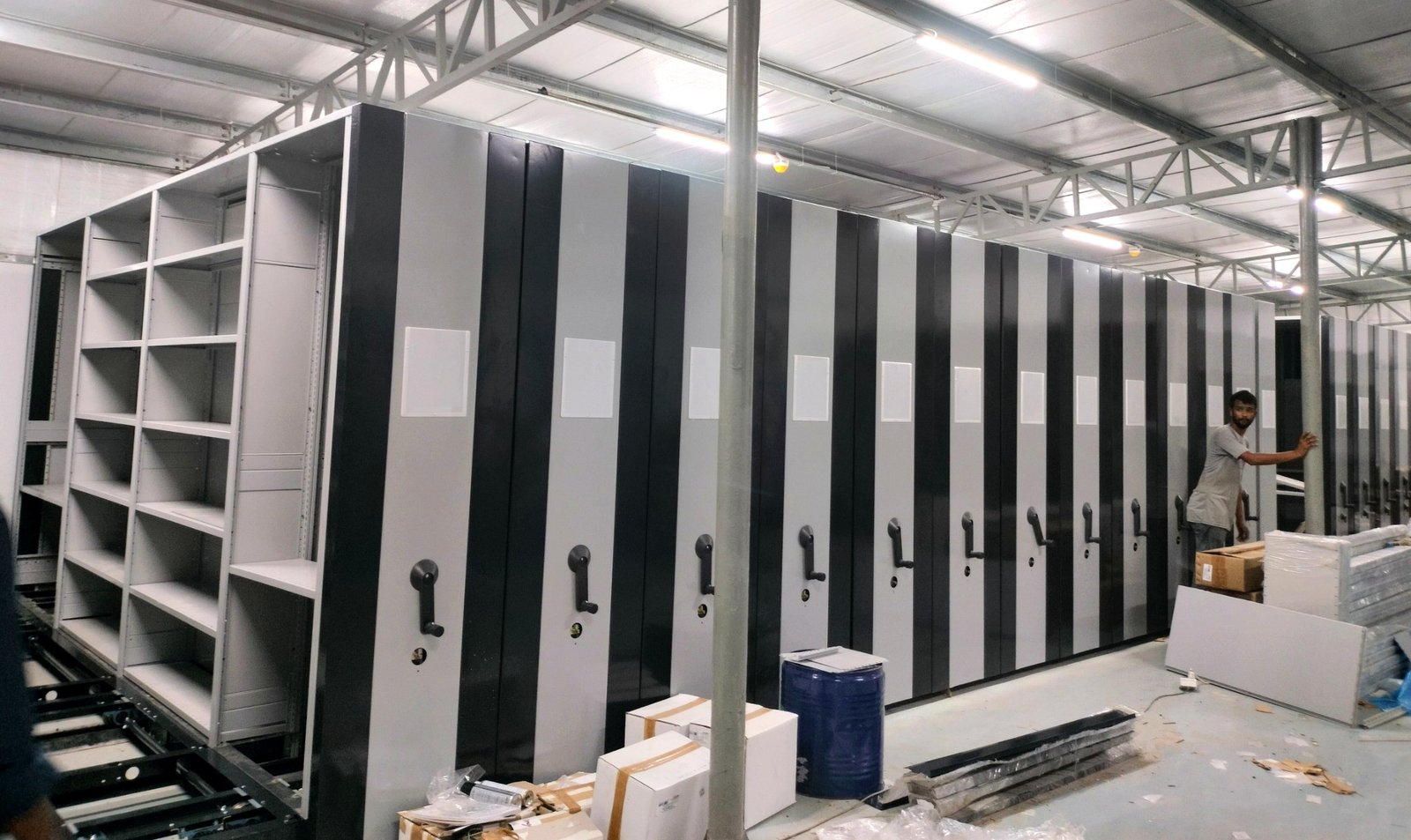
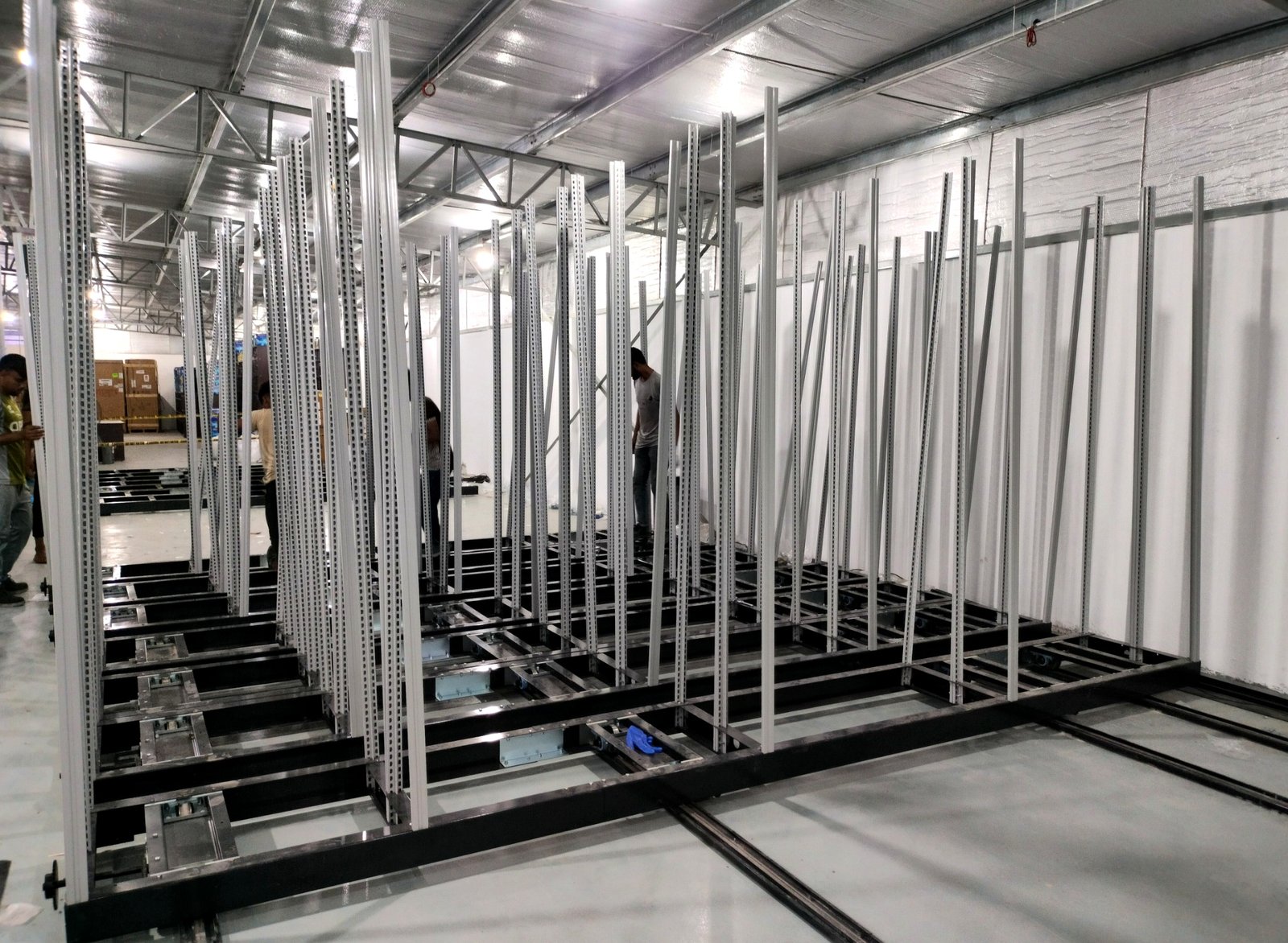
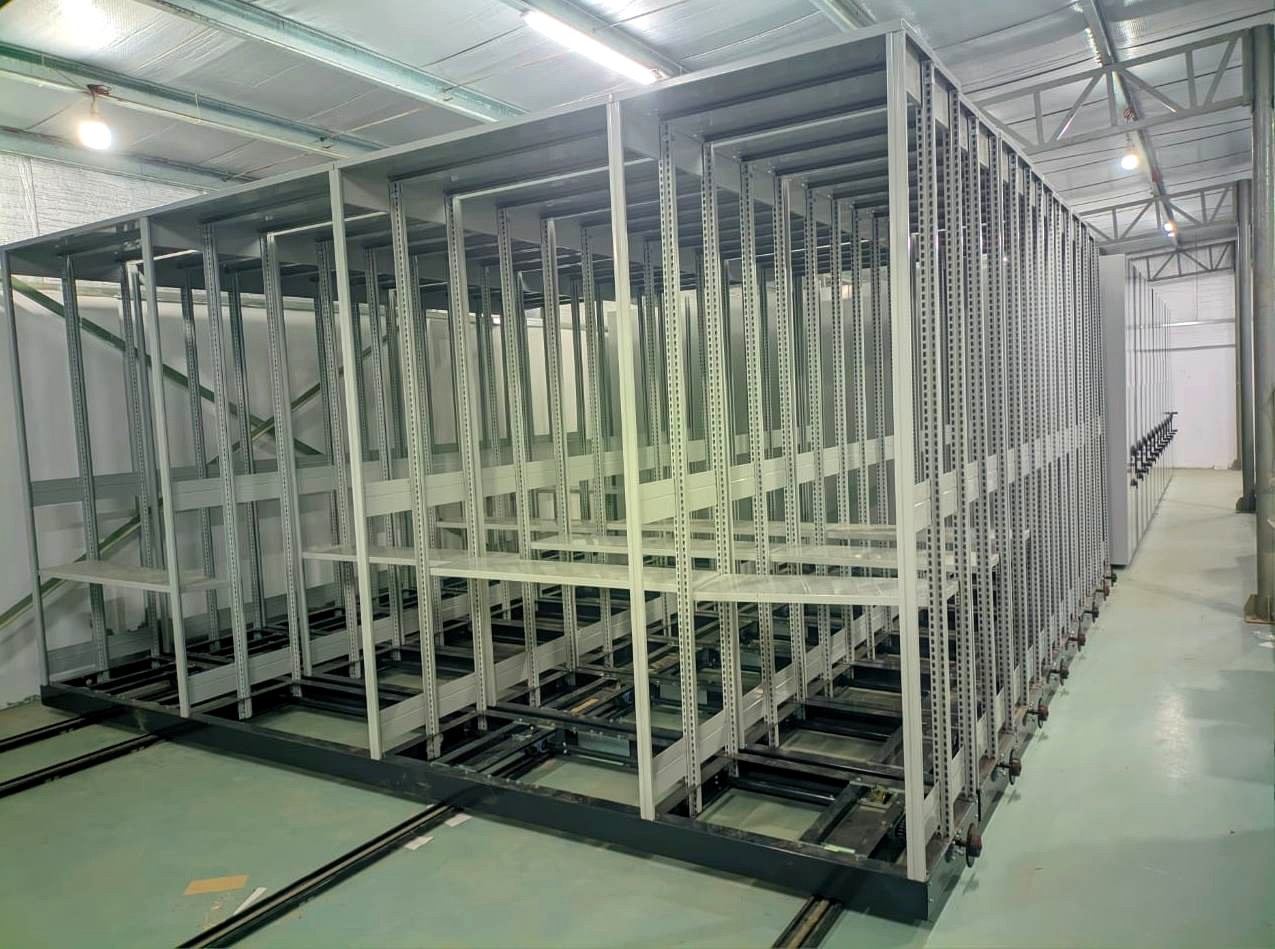
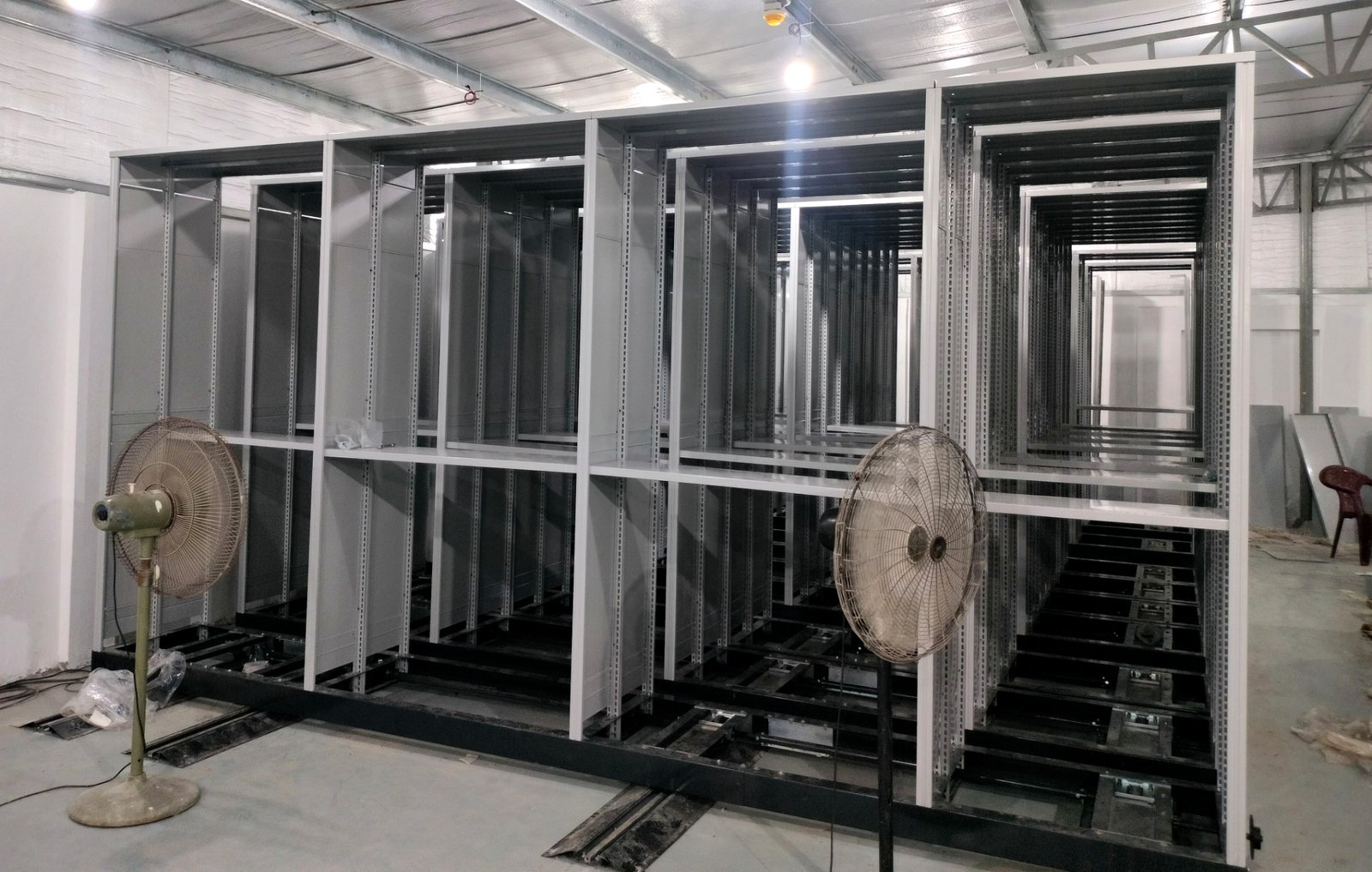
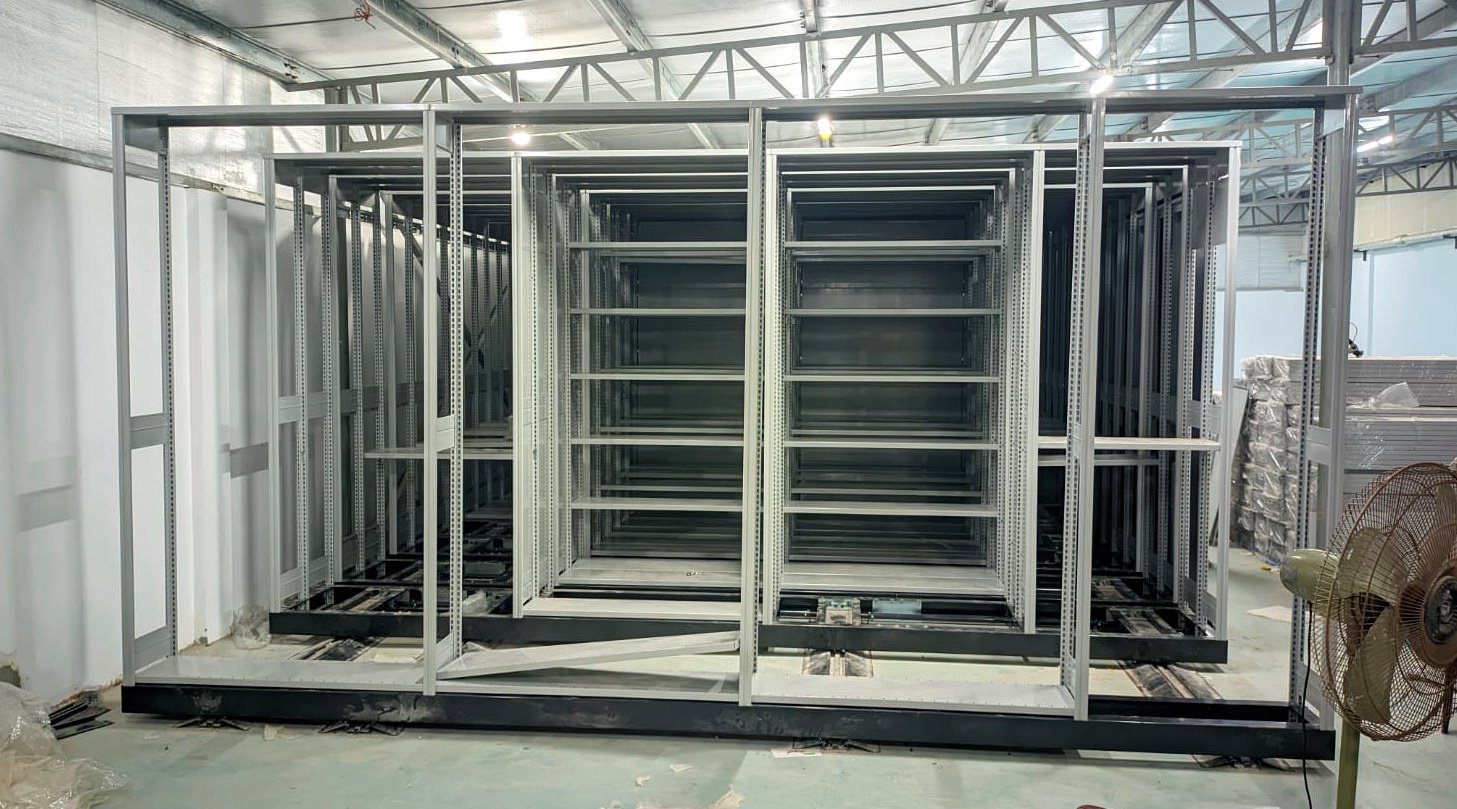
During the early stage, the floor rails, mobile bases and upright frames can be seen clearly. As the installation progresses, the shelving structure, steel decks and rack rows take shape. The completed section shows the mobile units with front panels and manual operating handles.
This gives a clear picture of how the MOBISTACK NEO mobile shelving system is built from the base up and how the finished archive racks are arranged inside the facility.
Floor Requirements
The floor condition was also an important part of the racking setup.
The drawing specifies that, for a minimum 1 m × 1 m grid, the difference in floor level between two survey points should be less than 4 mm. The maximum variation between any two survey points should not exceed 10 mm, while the floor load-bearing capacity is to be ensured by the customer.
The project documents also call for checks related to accessibility, material movement, pillars and relevant MHE parameters.
A Real Archive Storage Project
The Renata PLC project brings together 832 racks across 8 mobile blocks within a dedicated document archive area.
For companies looking for a mobile racking system in Bangladesh, document archive racking, mobile shelving system, compact archive storage, or industrial document storage solution, this project provides a real reference of an installed MACHLION storage solution using the Godrej MOBISTACK NEO system.
The project combines a large rack quantity, multiple storage levels and a mobile rail-based arrangement into one organized archive storage setup for Renata PLC.
Project Gallery
What We Solved
For Renata PLC, the main challenge was not simply to add more shelves. The real requirement was to organize a large document archive area in a way that could hold a high number of racks while still keeping the stored records accessible.
The available archive area was 5,328 SFT, and the final layout was developed with 8 mobile blocks, 104 racks in each block, 832 racks in total, and 6 storage levels.
MACHLION addressed this requirement using the Godrej MOBISTACK NEO Racking System, manufactured by Godrej. The result is a mobile archive storage setup where the rack blocks move on floor-mounted rails, allowing access to be created where it is needed instead of keeping a permanent aisle between every rack row.
Making Better Use of the Archive Area
In a conventional fixed shelving layout, every row normally needs its own access space. That means part of the available floor area remains dedicated to aisles.
For this project, the storage rows were arranged as mobile blocks running on rails. The real installation photos clearly show the rail system, mobile bases, shelving frames and completed manually operated rack fronts.
This approach allowed the archive area to be organized around the storage blocks themselves while still providing access through the movable arrangement.
For a company looking for a mobile racking system in Bangladesh, this is one of the most important parts of the Renata PLC project: the available archive space was used for a structured mobile shelving layout rather than a series of fixed shelving rows.
Creating a Large, Organized Archive in One Defined Area
The project brings together 832 racks within the 5,328 SFT document archive area.
Rather than having scattered shelving or separate storage sections, the archive was planned as one coordinated system made up of 8 blocks. Each block contains 104 racks, and each rack uses 6 storage levels.
This gives the archive a clear physical structure.
For Renata PLC, the benefit is not just the number of racks. The more important point is that the racks are arranged in a planned system where every block, level and storage section follows the project layout.
For businesses searching for a document archive storage system, mobile shelving system, or compact office and industrial archive solution, this project shows how a large number of storage positions can be organized inside a dedicated archive area.
Keeping Access Practical
A mobile storage system has to solve two things at the same time:
store a large number of items and keep those items accessible.
The MOBISTACK NEO setup uses movable rack blocks, so access can be opened between the required rows.
The completed project photos show manual operating handles on the front of the mobile units. This makes the movement system easy to understand visually: the rack blocks remain compact when access is not required, and the required aisle can be opened when a section needs to be reached.
This is one of the key advantages of using a mobile shelving system for document archives.
The solution is not about filling every available space with shelves. It is about combining storage density with a practical access arrangement.
Different Storage Loads Within the Same System
The archive system was also designed with different shelf load requirements.
The layout includes sections rated at 65 kg UDL per level and other sections rated at 90 kg UDL per level, depending on the rack configuration. The system uses 6 levels, and the Safe Working Load information specifies a maximum load of 390 kg per mobile base.
This is useful because not every storage section has been treated as identical.
Instead, the load arrangement follows the way the rack sections were designed.
For the customer, that means the archive system has clearly defined load limits rather than relying on a general or approximate capacity.
Organizing Different Stored Items
The project drawing also identifies different SKU types and defines where they are to be stored. In particular, the drawing notes that B-type SKU is to be kept on the top level, Level 6.
This helps give the archive system a more organized storage logic.
Rather than using all rack levels without any defined arrangement, the project includes a specific location rule for the B-type items.
For an archive environment, this kind of planned arrangement is important because the value of a storage system depends not only on how much it can hold, but also on how clearly the storage locations are defined.
A Safer and More Controlled Storage Setup
The project also includes safety-related features and instructions.
The drawing specifies one mechanical pin lock per block.
The installed safety information also provides clear instructions such as:
- do not overload the system,
- do not climb on the racking structure,
- do not remove installed components,
- do not alter the structure without approval,
- inspect and report accidental damage or dislodged components,
- and carry out regular inspection.
These points are important because a mobile racking system is not only about storage capacity. It also needs to be used within its defined operating and load limits.
Building the System Around the Actual Floor
The mobile rack blocks operate on floor-mounted rails, so floor condition is a critical part of the setup.
For this project, the floor requirements were clearly defined.
For a minimum 1 m × 1 m grid, the difference in floor level between survey points should be less than 4 mm, while the maximum variation between any two survey points should not exceed 10 mm. The floor load-bearing capacity is to be ensured by the customer.
The project documentation also calls for checks related to accessibility, pillars, material movement and relevant MHE parameters.
This shows that the project was not approached as shelves alone. The floor, rails, mobile bases, access and movement all form part of the complete storage arrangement.
From Rail Installation to Finished Mobile Shelving
One of the strongest parts of this project is the real installation record.
The photos show the system at several different stages:
- floor rails and mobile bases installed,
- upright frames being assembled,
- shelving structures taking shape,
- complete rack rows in position,
- and the finished mobile units with front panels and manual operating handles.
This gives potential customers a much clearer idea of what a mobile racking installation actually involves.
It also makes the Renata PLC project a useful reference for customers who are considering a similar archive racking system in Bangladesh but want to see an actual installation rather than only a catalogue image.
What Makes This Solution Different
The main strength of the Renata PLC project is the combination of compact storage, mobile access and a clearly defined archive layout.
The solution brings together:
- a dedicated 5,328 SFT document archive area
- 8 mobile storage blocks
- 832 racks
- 6 storage levels
- steel decking
- different shelf load configurations
- a defined maximum load per mobile base
- mechanical pin locking
- floor-mounted rail operation
- and a planned SKU arrangement
The project therefore goes beyond simply supplying racks.
It creates a complete mobile archive storage system where the shelving, movement, load limits and access arrangement work together.
The Solution in Simple Terms
Renata PLC needed to organize a large number of archive racks within a defined storage area.
MACHLION provided the solution using the Godrej MOBISTACK NEO Racking System, manufactured by Godrej.
Instead of using fixed rows with permanent aisles, the project uses mobile rack blocks running on rails. This allows the archive to remain compact while still providing access to the required storage section.
With 832 racks across 8 mobile blocks and 6 storage levels, the project gives Renata PLC a structured document archive setup built around the actual available space and confirmed project layout.
For companies searching for a mobile racking system in Bangladesh, document archive racking system, mobile shelving system, compact storage solution, high-density archive storage, pharmaceutical document storage, or industrial archive shelving, the Renata PLC project provides a real example of a MACHLION mobile storage solution implemented with the Godrej MOBISTACK NEO system.